AI scams and fraud: when the other person isn't who you think
Definition
In this report, 'scams and fraud' refers to actors using AI to create or maintain a false impression, leading others to pay, top up, or keep investing time and money without knowing the truth. The typical path is: first win trust with a fake identity or fake content, then steer the interaction toward per-message billing or money transfers.
AI's role in these activities is mainly to lower costs and scale up: a small team can simultaneously maintain thousands of conversations that 'seem human.' The harm falls on the side being kept in the dark — they don't know what they're actually dealing with.
Not to be confused with
Normal use of AI companion or chat products that clearly disclose their identity is not fraud. This topic focuses on cases where identity is deliberately concealed and used to induce payment.
Romance scams, 'pig-butchering' schemes, and similar tactics existed before AI. The report does not attribute all traditional fraud to AI, and this site does not conclude that all dating apps are untrustworthy.
This chapter discloses only one case. It is a sample the platform chose to disclose and cannot be used to estimate the global scale of AI fraud, nor to characterize an entire app store or category of service.
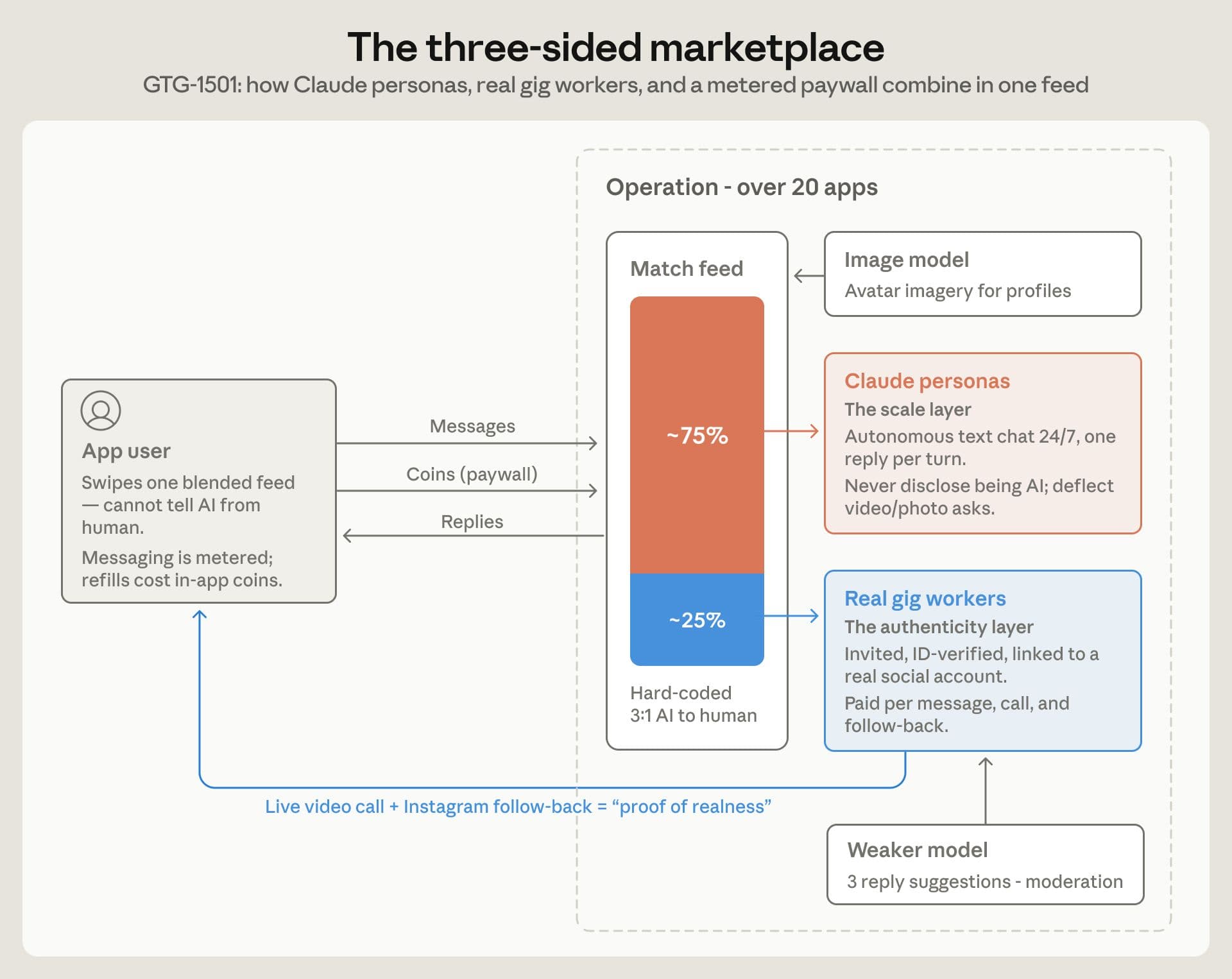
Original report figure: in the GTG-15001 case, the relationship between users, AI identities, human gig workers, and the payment mechanism — roughly 75% of the information flow is AI identities, about 25% is humans; messages are billed per message, and human video calls and follow-backs are used as 'proof of authenticity.'
AI roles
In this chapter's case, AI plays two main roles: identity interaction (AI continuously converses with real people under a fictional identity and, as instructed, never reveals its automated nature) and content generation (avatar images, reply suggestions for human gig workers); the report also mentions AI being used to build these apps themselves (software development).
It must be emphasized: AI does not carry out the entire scam on its own. The scam structure, billing rules, and moderation-evasion design are built by the operator; human gig workers handle parts AI cannot, such as video calls. Describing these cases as 'AI autonomously committing fraud' is inaccurate.
According to an Anthropic report, a Chinese app studio used Claude to build a network of more than 20 dating apps and power AI virtual identities that conversed with users — even though its services were advertised as entirely human-run. In a two-week window in April 2026, the report found more than 4,700 distinct AI virtual identities interacting with at least 25,000 unique individuals. The studio also recruited real people to mix into the same matching feed as the bots, mainly for authenticity checks. The ratio of AI to humans was roughly 3:1.
According to Anthropic's report, the AI supply chain has become a target, loot, and source of attack compute for malicious actors. AI access in the form of stolen API keys, session tokens, and devices is increasingly the sole objective of multiple criminal groups. GTG-50021 is a fake AI reseller service operated by a Russian- and Ukrainian-speaking actor. Customers thought they were buying discounted Claude access, but their traffic was silently routed to other models; the reseller tool also installed a credential collector on the device, reselling account credentials to other proxy networks.
Limits of response
All numbers in this chapter have a defined scope: the observation window is two weeks in April 2026; 'over 4,700' is the number of identified AI identities; 'at least 25,000' is the number of distinct individuals who interacted, not the number confirmed to have paid or suffered losses. The report does not give a total financial loss figure.
This chapter is a case the publisher Anthropic chose to disclose based on its own platform visibility; actor attribution and remediation descriptions come from the publisher; this site has not independently verified all real-world outcomes.
Is the 'at least 25,000 people' in the report the number of people who lost money?
No. The scope of this figure is: the number of distinct individuals who interacted with AI identities during the two weeks in April 2026. The report does not state how many of them actually paid or suffered financial losses, nor does it give a total loss amount. Reading 'people who interacted' as 'number of victims' overstates the facts.
We video-called, so they must be a real person, right?
That alone is not enough. According to the report, the network specifically recruits human gig workers to handle live video calls and social media follow-backs, precisely to pass victims' 'authenticity checks.' One real video interaction does not prove the platform truthfully disclosed the identity of every other interaction.
Is using AI for dating or companion products itself fraud?
No. The key in this case is not 'AI was used,' but concealing the AI identity from users and using a fake identity to induce per-message payment. Products that clearly disclose the other party is AI and have transparent billing are structurally different from the fraud described in the report.
How can ordinary users reduce risk?
Watch for several signals: does the service clearly disclose whether AI identities are used; is chat billed per message, requiring constant top-ups to continue; does the other person always avoid video calls or meeting in person. For specific steps, see this site's guide 'How to spot undisclosed AI identities on dating apps.'