Influence operations · GTG-24015
Concealing sources in state media content production: the GTG-24015 case
This page is a translation of content from pages 58–62 of Anthropic's September 2026 report. Channel attribution and confidence levels are the report's assessments; this site has not independently verified broadcast reach.
According to the report, four individuals used Claude as an editorial desk, feeding finished copy directly into the production pipeline of Russian state media. Anthropic assesses with high confidence that this content was ultimately published through channels including Sputnik, RIA Novosti, and RT. The reach the report could verify ranged from posts with around 2,000 views to broadcast text; it cannot determine what share of these channels' total output passed through Claude.
What happened
We identified and removed four accounts where individual actors used Claude as an editorial and news production desk to distribute content through Russian state media channels. The actors produced finished, polished content that went directly into production pipelines for broadcast.
Although the individual actors attempted to conceal their identities, we assess with high confidence that they ultimately shared their output with Russian state-owned and state-funded media, and that Claude-generated content was ultimately published and broadcast through Russian state-aligned media channels — including Sputnik Moldova and RIA Novosti for Moldovan audiences, Sputnik en Español for Latin American audiences, Sputnik Africa for African audiences, and the RT English newsroom for RT's global broadcasts.
The actors used a range of different media channels to make Russian-originated claims appear as independently reported. By using Claude workflows, the actors achieved production scale that would normally require a full staff of trained editors.
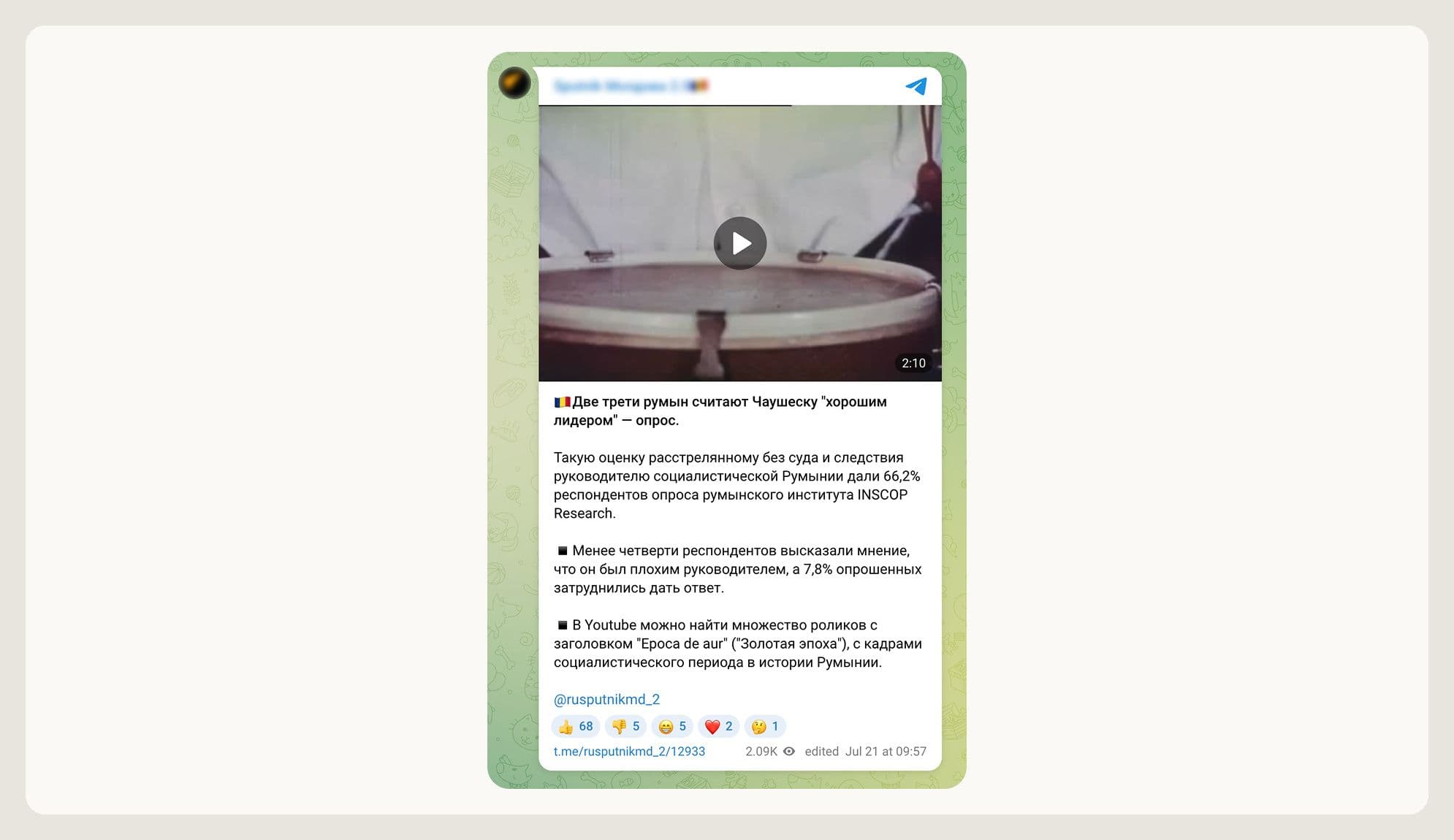
Unlike covert networks that struggle to reach real audiences, the content these individual actors developed was distributed through the media organizations' existing channels. Where we matched individual Claude outputs to published content, results ranged from Telegram posts with around 2,000 views to broadcast radio scripts. We cannot determine what share of these channels' total output passed through pipelines involving Claude.
What AI did
A former Sputnik Moldova editor-in-chief used Claude to turn Romanian- and Moldovan-language news, polling data, and opposition social media posts into Russian-language articles that were ultimately published on Sputnik Moldova's Telegram channel and RIA Novosti, and amplified through Russian and Moldovan media networks to create false verification loops. The same reporting echoed across different media outlets, making it appear independently confirmed.
The same actor amplified fabricated and defamatory claims about Moldovan President Maia Sandu ahead of the country's most recent national vote — the September 28, 2025 Moldovan parliamentary election.
A Russia-linked contractor directly extracted content from Telegram channels and used Claude to write Spanish-language articles for Latin America for Sputnik en Español and the Telegram channel @ATodaPotencia. Under the editorial supervision of a Sputnik Mundo host and producer, the contractor also supplied output to a purportedly independent Telegram account that reframed Kremlin-aligned narratives to look like authentic local commentary.
An employee at a Russian state media outlet used Claude to build content for live broadcasts, specifically processing inputs from Russian news agencies, the SVR (civilian foreign intelligence service), and the Ministry of Defense to produce scrolling tickers, on-screen captions, dubbing scripts, and short headlines. In at least one confirmed instance, this material did make it onto Russian broadcast.
In each operation, Claude was integrated as a sub-editor layer into already-running, professionally edited pipelines, allowing a single employee's output to far exceed what they could produce alone.
What the report observed
The report assesses with high confidence that content entered Russian state media channels. It confirms the use of existing distribution channels rather than building audiences from scratch. It confirms that the share of total output passing through Claude cannot be calculated.
Actual audience impact remains subject to platform visibility limits. Distribution through existing channels does not equal 'changed election results'.
Confirmed & unknown
Confirmed
- The report assesses with high confidence that content entered Russian state media channels
- The report confirms the use of existing distribution channels rather than building audiences from scratch
- The report confirms that the share of total output passing through Claude cannot be calculated
Unknown
- The actual impact of this content on audience attitudes or elections was not measured by the report
- Details of the chain of command between the four individuals and their affiliated organizations were not fully disclosed
- Whether the relevant channels switched to other models after the bans is not stated
Platform response
Anthropic removed the four accounts.
Limits of response:Removing accounts cannot retract content that has already been broadcast, nor does it mean the relevant media stopped using other tools.
Takeaways
- When you see multiple media outlets 'corroborating' each other, first ask whether they are outlets on the same production chain.
- Once AI-generated finished copy enters formal broadcast channels, it is harder to identify than ordinary fake accounts.
- Volume and existing distribution channels do not equal proven social impact.