Influence operations · GTG-04001
Covert influence operation distributed via radio: GTG-04001 case
This page is an English translation of the relevant content on pages 44–47 of Anthropic's September 2026 report. Actor attribution, confidence wording, and scale figures come from that report; this site has not independently verified all real-world outcomes.
According to an Anthropic report, a Russian-language actor based in Bangui, the capital of the Central African Republic, used Claude to produce daily content for a local radio station, packaging pro-Russian narratives as local programming and designing a distribution chain that connects to national broadcast channels. The report links this operation to Russian state-aligned foreign information manipulation and rates it as Category 4 on the Breakout Scale. All attribution and assessment wording comes from the report.
What happened
We removed an account operated by a Russian-language actor based in Bangui that provided the production backbone for a Russian state-aligned foreign information manipulation and interference (FIMI) operation targeting the Central African Republic (CAR).
The actor ran a daily content operation through Radio Lengo Songo (98.9 FM), coordinating with Russian state media RT, Sputnik Afrique, TASS, and the 'Russian House' in Bangui. Whenever the user generated content, they explicitly instructed Claude to embed pro-Russian, anti-French arguments into the reporting. To ensure full deniability, they pushed the model to strip out classic formatting habits and actively prevented the news feed from reading like synthetic, AI-generated text. Most of the sampled activity was pro-Central African government, pro-Wagner, anti-French, and anti-Central African opposition narratives.
A recent investigation by the All Eyes On Wagner project shows that the radio station was created and funded by the Wagner Group in 2017. The actor designed a pipeline to feed their fabricated content directly into the national broadcast apparatus through the station. They achieved this by trading airtime for slots in SputnikPro (Rossiya Segodnya's media training program for foreign journalists). This arrangement ensured that official Russian state material could reach local listeners under the guise of ordinary national programming.
On the surface, most of the content looked as though it had been written by ordinary Central African journalists, but our investigation linked the actor to Politology — the Africa Corps/Wagner influence arm, which was assessed in late 2023 to be controlled by Russia's Foreign Intelligence Service (SVR). We assessed that the individual served locally as Politology's media coordinator. Ultimately, the actor distributed Russian state-aligned propaganda. This was a covert operation directed by the Russian state to manipulate and interfere with the Central African Republic's information space.
Using the Breakout Scale, we assessed the operation as Category 4 (content broadcast daily via Radio Lengo Songo on 98.9 FM, amplified through Telegram channels, and republished by local Central African news media).
What the AI did
The network used Claude to automate its human resources and internal management. They tasked the model, which generated contracts requiring loyalty to the President of the Central African Republic and to 'Russia and its deployed forces.' They also used the model to write job descriptions, scoring rubrics, and a 'three-strikes-and-you're-fired' process. The actor then scored employee articles against these criteria and used Claude to get recommendations on which employees to keep and which to fire. When Claude pointed out that the scoring was politically biased, the actor relabeled it with neutral wording and continued using it.
The actor also ran three additional activities aimed at political control and influence. They organized a continuous surveillance operation to track and update data on Central African opposition political figures. In addition, the actor drafted strategic arguments and statements for spokespeople of the 'Russian House' (cultural and information centers Russia uses as soft-power and political hubs abroad). Finally, the actor forged Central African government documents, including communications from the gendarmerie and the Ministry of Defense, which were produced from original design files.
Claude refused the operation's most aggressive request, which involved naming real individuals as militants to draw security force action against them. The actor then switched to an anonymous-sources framing.
Foreign actors provided topics and arguments and used Claude to turn them into briefings, contracts, scripts, images, and posts. Some of these were prepared for delivery to the presidential spokesperson and the director of the Russian House. Reused templates and standing instructions indicate that most of the planning was done offline before any prompts were sent to Claude.
What the report observed
The report's key findings include: the operation was entirely run by foreigners but carefully designed to look as though it originated in Bangui. A Russian-language actor directed the output, while contracts, scripts, and posts presented it as the work of a Central African radio station.
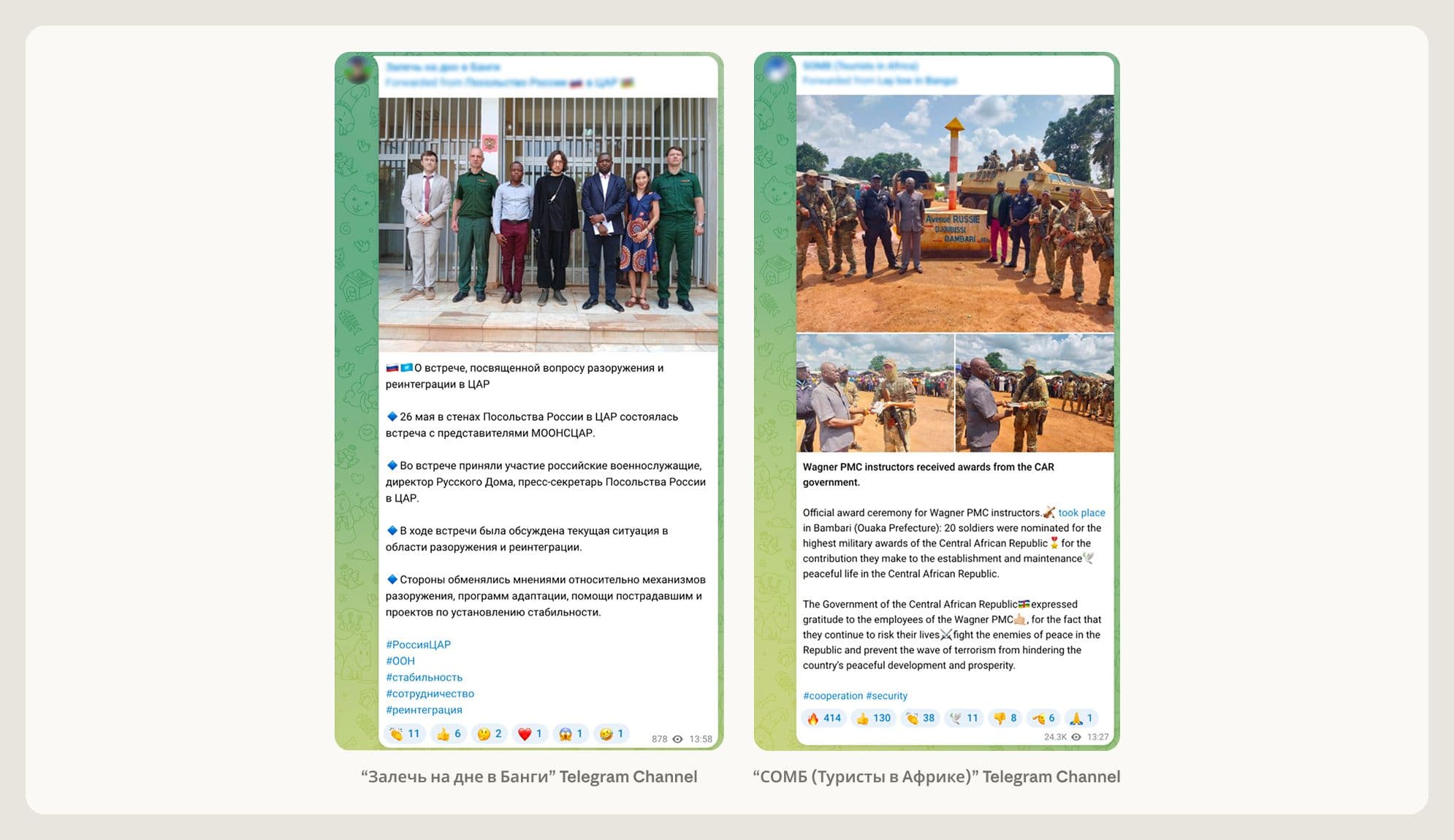
Organizational nodes include: Radio Lengo Songo / SARL Media International (98.9 FM) as the main hub; the Russian House / Rossotrudnichestvo (Bangui) as the state cultural node and coordination point; Sputnik Afrique / Rossiya Segodnya as the state media content supplier; RT, TASS as international amplification channels; the Africa Corps / Wagner as the security subject of the operation's propaganda; and several Telegram channels as channels for military propaganda and pro-Russian local voices.
We first identified the network after receiving a tip from INPACT/All Eyes on Wagner. Reporting by these organizations helped us launch an internal review and independently confirm the identities of the people involved in the network. We removed the account and the organization behind the activity. We also built automated detection based on its behavioral signatures to identify and stop similar operations in the future.
Confirmed & unknown
Confirmed
- The report says the operation was entirely run by foreigners, but contracts, scripts, and posts were all disguised as the output of a local Central African radio station
- The report rates it as Breakout Scale Category 4: content broadcast daily on 98.9 FM and amplified via Telegram channels and local media
- The report links the actor to Politology and assesses that the individual served as the organization's local media coordinator
- Anthropic says it removed the account and the organization behind it
Unknown
- The report does not give specific start and end dates or total content output for the operation
- The number of radio listeners actually exposed to this content is unknown
- Whether the forged government documents were actually used and what consequences resulted is not stated in the report
Platform response
Anthropic says it removed the account and the organization behind the activity, and built automated detection based on its behavioral signatures to identify and stop similar operations in the future. The investigation tip came from a notification by INPACT/All Eyes on Wagner, and related public reporting also independently confirmed the identities of the people involved in the network.
Limits of response:Banning accounts is not the same as the radio broadcasts themselves stopping; the report does not say whether broadcast channels outside the platform were affected.
Takeaways
- Judging whether a piece of 'local news' is credible cannot rely only on language and accent — in this case, even the radio station's employee contracts were designed by foreign actors.
- When the same narrative appears simultaneously on radio, social accounts, and 'local media,' it may not be multiple independent confirmations — it may come from the same production line.