Surveillance operations · GTG-14010
Surveillance and outreach targeting diaspora communities: GTG-14010 case
This page is an English translation of the relevant content on pages 86–89 of Anthropic's September 2026 report. Institutional affiliation is the report's assessment. This site only discusses group-level risks and does not provide any individual profiles or contact information.
According to the report, an operation aligned with the Chinese government's collection direction used Claude to track, profile, and attempt to recruit members of Uyghur communities in Syria. The operator did not speak Arabic, and the model provided dialect drafting, real-time translation, and task quality checks. The report assesses with low confidence that the operator was a contractor rather than a direct national security organ. The ethnic label is the target background described by the report, not an indication that the group itself is at risk.
What happened
We identified an operation aligned with the government of the People's Republic of China that used Claude to track, profile, and recruit Uyghur people and Uyghur armed formations in Syria. The armed targets were Uyghurs who had recently joined the newly formed Syrian army, formations designated as terrorists by the Chinese government. The actor used Claude to target and communicate with individuals in Syria assessed as likely to have contact with these formations. The actor then attempted to recruit these individuals, including by offering payment in exchange for reports about these forces.
In addition, the actor used Claude to locate specific Uyghur businesses and points of interest in Syria. This occurred alongside a broader surveillance operation targeting Uyghur diaspora journalists, and a commercial operation drafting surveillance platform bids for government clients. The actor worked in Chinese, and the operation's collection priorities aligned with Chinese national security priorities. We assess with low confidence that the actor was a contractor working on behalf of Chinese national security, rather than a national security organ acting directly.
What the AI did
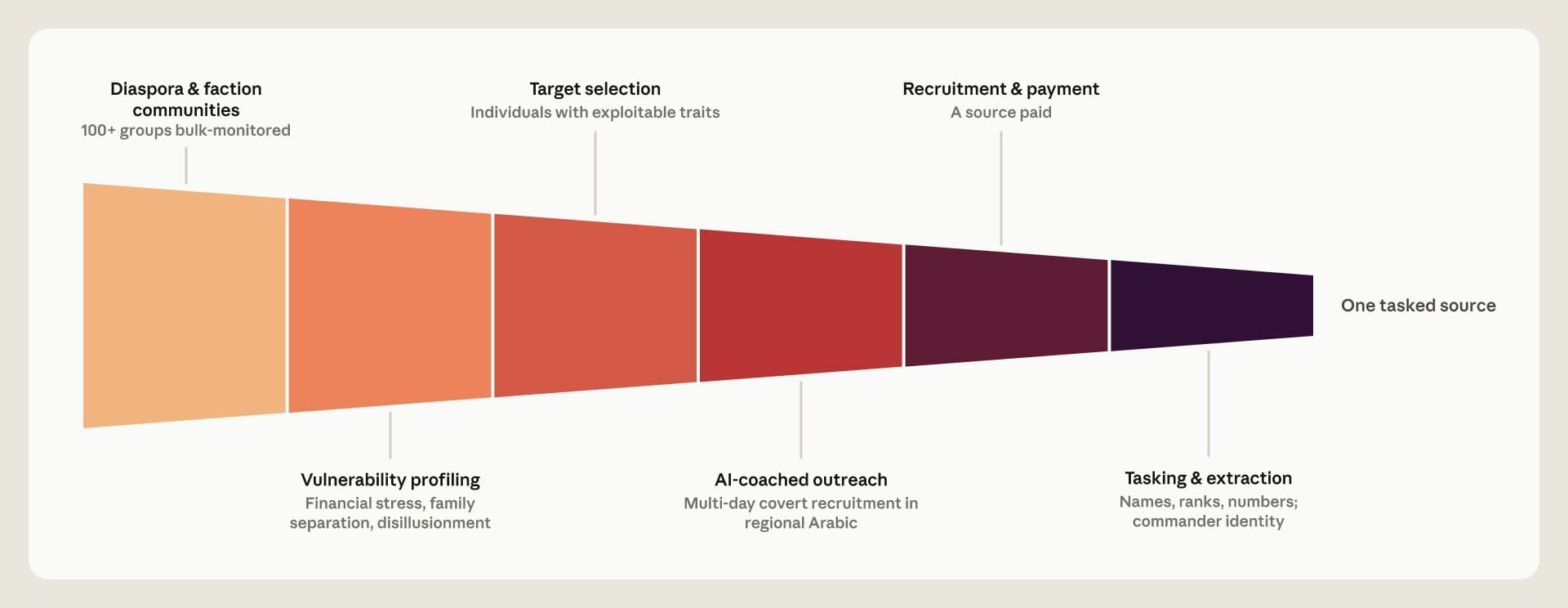
The actor used Claude to convert chat content bulk-extracted from more than 100 monitored WhatsApp groups and dozens of Telegram channels into structured Chinese data. This included building profiles of individuals likely vulnerable to targeting due to financial pressure, family separation, and ideological disillusionment. The actor specifically identified targets whose family members remained in Xinjiang — a form of leverage that can only be exploited through coordination with Chinese domestic security authorities.
The actor instructed Claude to play the role of an Arabic-speaking 'expert' advisor, performing quality checks on their deceptive messages for dialect, military terminology, and target psychology.
At the same time, the actor orchestrated a coordinated mass-reporting, foreign-front de-legitimization, and bot-network amplification operation targeting Uyghur diaspora journalists, particularly those working for the Uyghur Post.
The actor drafted surveillance platform bids and capability manuals for bureau-level Chinese government clients, indicating a government-client-to-vendor operational structure.
Claude refused several requests for covert interrogation and mass generation of fake personas.
What the report observed
The operation spanned the full intelligence chain. In the collection and analysis phase, the actor used independent infrastructure (separate from Claude) to bulk-extract chat content from social media groups. They then used Claude as an offline analysis layer to correlate identities across platforms, map networks, profile individuals based on exploitable vulnerabilities, and generate Chinese-language reports, as well as detailed plans to suppress Uyghur diaspora media. In the execution phase, the actor used Claude to orchestrate multi-day covert recruitment operations against targets in Syria, written in Syrian Arabic dialect. Claude translated replies in real time, played the role of an 'expert' advisor to quality-check the deception, and formatted documents for delivery up the reporting chain.
The actor used Claude to eliminate the need for native-language skills and specialized personnel. This enabled a single actor who did not speak Arabic to maintain a credible covert outreach operation, create structured databases for monitoring individuals, geolocate specific individuals, and create the commercial and influence infrastructure needed to support the operation.
Confirmed & unknown
Confirmed
- The report says the operation aligned with the Chinese government's collection priorities
- The report confirms the actor did not speak Arabic, and Claude provided dialect drafting, real-time translation, and quality checks
- The report assesses with low confidence that the actor was a contractor rather than a national security organ acting directly
- The report confirms Claude refused several covert interrogation and mass fake persona requests
Unknown
- The actor's true identity and employer are not confirmed in the report
- Whether the recruitment operation succeeded is not stated in the report
- Whether the monitored journalists suffered actual harm is not stated in the report
Platform response
Anthropic banned the relevant accounts and notified relevant parties of the findings.
Limits of response:Banning accounts cannot recover already collected data, nor can it prevent the actor from continuing activities using other tools.
Takeaways
- AI lowers the barrier to cross-language surveillance and outreach: someone who does not speak the target language can maintain a credible covert operation.
- Family members remaining in the country of origin is a form of leverage that can be exploited, requiring cross-national security coordination to address.
- Surveillance platform bids and commercial operations indicate that a government-client-to-vendor operational structure may exist.