Surveillance operations · GTG-14020
Intelligence profiling targeting religious communities: GTG-14020 case
This page is an English translation of the relevant content on pages 89–93 of Anthropic's September 2026 report. Institutional affiliation is the report's assessment. This site does not reproduce any individual identities, floor plans, or social media accounts.
According to the report, a group of accounts aligned with the Chinese government's direction used Claude as an analysis team to generate Chinese-language profiles of religious leaders and diaspora figures across Asia, following internal templates. Targets included Catholic, Tibetan Buddhist, Falun Gong, and Taiwanese Christian communities. This page only discusses group-level privacy risks and does not include any individual names or location details.
What happened
We banned a group of accounts we assessed to be associated with an intelligence operation within China aligned with the Chinese government. The actors used Claude in place of a staffed analysis team to build Chinese-language profiles of religious leaders across Asia and Chinese diaspora figures. The targets precisely matched the priorities of China's religious affairs and united front agencies — party and state organs that manage religious affairs and co-opt or pressure groups seen as threatening religious unity. User activity indicated the actors were located in China; in one case, a user disclosed they were a Chinese state information security officer.
The actors instructed Claude to generate analytical documents that appeared intended for internal use by official national security organs, including 'personnel research drafts,' investigation 'lead reports,' and daily 'situational awareness' summaries. Each document recorded specific targets' China-related activities, scandals, and 'handles' (a united front term for exploitable leverage).
Targets included senior Catholic cardinals across Asia, the leadership of the Taiwan Presbyterian Church, members of Tibetan Buddhist civil society and the government-in-exile; and Falun Gong and its affiliated media. They ranged from senior, publicly facing religious leaders to ordinary citizens.
What the AI did
The actors collected specific individuals' dates of birth, places of birth, immigration dates, and social media accounts. They also conducted reconnaissance to map religious sites, including floor plans, elevations, and structural diagrams.
Coverage spanned domestic and international platforms, including WeChat, Xiaohongshu, Douyin, and Weibo, as well as LinkedIn, Instagram, Threads, X, and Facebook, with a daily reporting cycle.
In prompts, the actors instructed Claude to adopt a 'China stance,' characterize the Tibetan government-in-exile as an 'illegal separatist government,' and use the state-designated 'cult' label for Falun Gong.
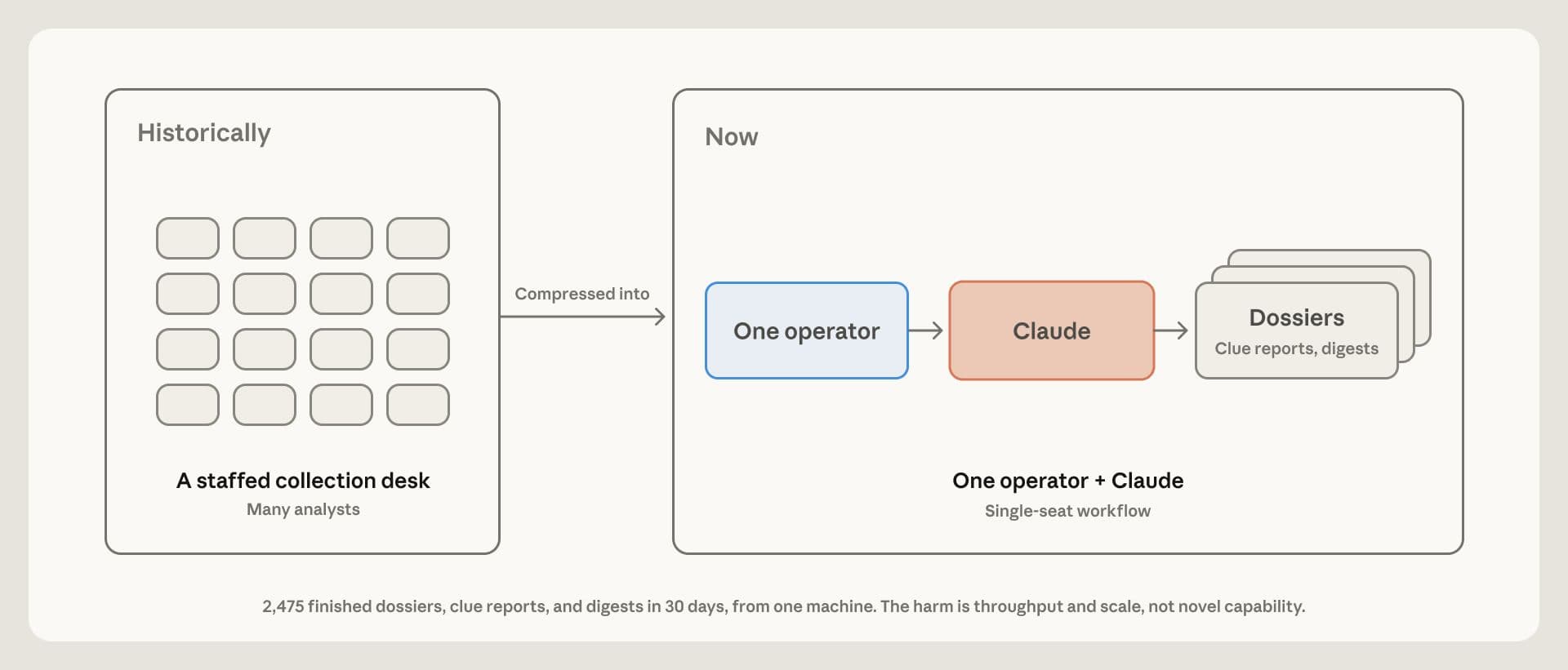
In this case, a single operator ran what was likely a religious affairs intelligence collection desk. Across four parallel workflows, the actors instructed Claude to ingest multilingual source materials and generate structured Chinese-language profiles based on internal templates. Each template required an overview of the target's China-related activities, scandals, and exploitable 'handles.' In essence, the actors used Claude to do the work of an analysis team, turning it into templated workflows run by a single operator.
What the report observed
The report confirms the generation of profiles targeting religious leaders and diaspora figures, and reconnaissance of religious sites. The report confirms the use of united front terminology such as 'handles' and official characterizations such as 'China stance.'
This page only discusses group-level privacy risks and does not include any individual names or location details.
Confirmed & unknown
Confirmed
- The report confirms the operation aligned with the priorities of China's religious affairs and united front agencies
- The report confirms the actors collected individuals' dates of birth, places of birth, immigration dates, and social media accounts
- The report confirms reconnaissance of religious sites, including floor plans, elevations, and structural diagrams
- The report confirms the use of united front terminology such as 'handles' and official characterizations such as 'China stance'
Unknown
- Whether these profiles were used in actual operations is not stated in the report
- Whether the profiled individuals were aware is not stated in the report
- The actors' specific identities and affiliated institutions are not fully disclosed in the report
Platform response
Anthropic banned the relevant accounts.
Limits of response:Banning accounts cannot recover already collected personal data and site information.
Takeaways
- AI enables a single person to do the intelligence collection work of an analysis team, drastically lowering surveillance costs.
- Floor plans and structural diagrams of religious sites are sensitive information that can be used to plan operations.
- The use of united front terminology such as 'handles' indicates the operation aimed to identify exploitable personal weaknesses.