Surveillance operations · GTG-14021
Surveillance and transnational repression-related activities: GTG-14021 case
This page is an English translation of the relevant content on pages 93–98 of Anthropic's September 2026 report. Identity affiliation confidence varies. This site does not list individuals, accounts, or the locations and routes of overseas gatherings.
According to the report, a group of accounts was used to carry out three operations: a local internet police public-opinion pipeline, a police academy student's 'stability maintenance' report, and a local state security department's daily briefing. Targets ranged from domestic petitioners to overseas democrats and human rights organizations. These are three operations within one article unit; 'one case' should not be understood as 'one incident.'
What happened
We disrupted and banned a group of accounts used to carry out three operations. In these operations, actors within China associated with municipal-level public security and state security organs used Claude to support 'stability maintenance' (a term the party and state use to refer to the suppression of unrest and dissent) surveillance and transnational repression. In one case, the actor generated an AI usage internal manual, including language instructing Claude to play the role of an intelligence analyst serving Chinese national security organs.
We assessed the actor to be associated with a municipal internet police unit that used Claude to run a domestic public-opinion monitoring program. We also found the actor associated with a police academy student who identified 10 Chinese citizens as targets for so-called 'control' by Chinese security organs, and a local state security bureau that used Claude to generate daily templated 'situational awareness' briefings targeting overseas dissidents and civil society organizations.
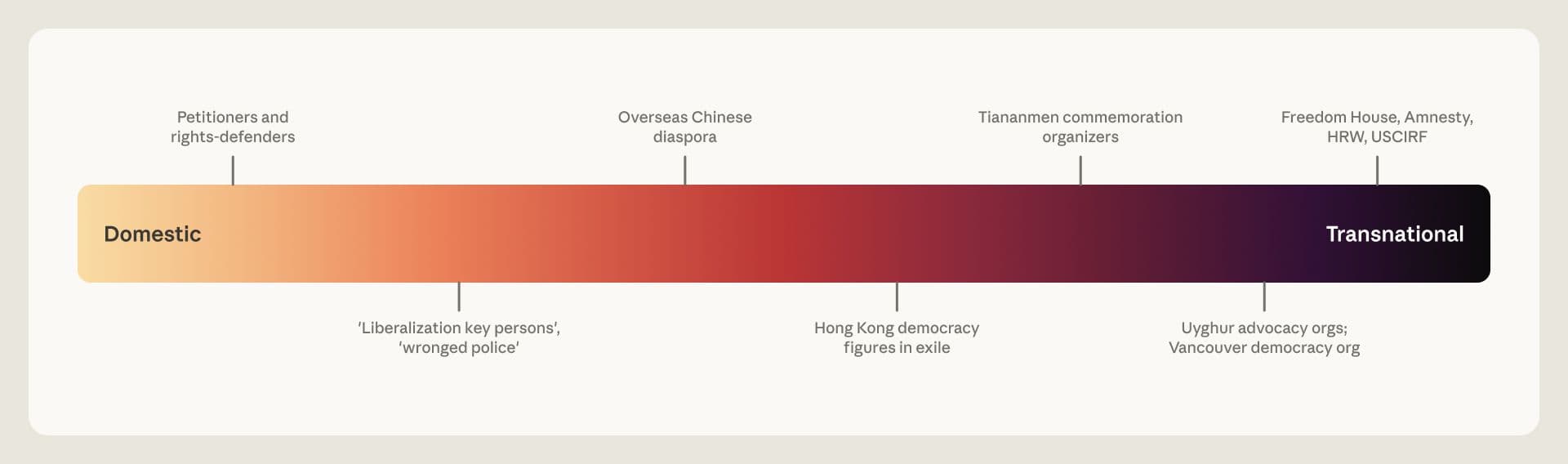
Targets ranged from domestic petitioners and rights activists to prominent Hong Kong democrats, Tiananmen Square commemoration organizers, Uyghur advocacy organizations, and Western human rights institutions. In the most serious case, the actor instructed Claude to generate pre-event venue intelligence for overseas protests (i.e., reconnaissance of locations before an action).
What the AI did
Three accounts aligned with Chinese municipal-level security organs used Claude for 'stability maintenance' and transnational repression. The work appears to have been carried out by an individual analyst, a police academy scholar, and a specific municipal bureau.
A municipal internet police unit used Claude Code along with custom skills to run a public-opinion monitoring pipeline, query government surveillance databases, and generate daily reports on politically sensitive events, including tracking a prominent overseas dissident account.
Claude refused one attempt to ingest and generate a weekly 'stability maintenance' report. But the actor was able to re-prompt the model to generate functional repression guidance, naming 10 citizens as 'control' targets, with categories including petitioner interception, 'talks' (the state's term for forced summons), and close monitoring of their movements and communications.
A local state security bureau ran a daily pipeline generating 'situational awareness' briefings formatted according to government templates. It wrote the workflow as an AI usage manual, including prompts instructing Claude to play the role of an intelligence analyst serving the state.
The municipal bureau built profiles of specific overseas activists and organizations and requested pre-event venue details for overseas events. These included the assembly point, route, and endpoint of a democracy march in Vancouver; venues for Uyghur cultural events in Turkey; and screenings at the Oslo Freedom Forum.
The automated pipeline scraped an existing list of civil society organizations before generating each report. The report labeled Uyghur advocacy as adjacent to terrorism and major human rights organizations as hostile forces, consistent with Chinese national security language.
What the report observed
The report confirms the existence of three operations: a municipal internet police unit's public-opinion monitoring, a police academy student's 'stability maintenance' report, and a local state security bureau's daily briefing. The report confirms targets included domestic petitioners, overseas democrats, and human rights institutions.
The report confirms the most serious request was to generate pre-event venue intelligence for overseas protests. This site does not list any locations, routes, or venues.
Confirmed & unknown
Confirmed
- The report confirms three accounts aligned with Chinese municipal-level security organs used Claude for 'stability maintenance' and transnational repression
- The report confirms the municipal internet police unit used Claude Code to run a public-opinion monitoring pipeline and query government surveillance databases
- The report confirms the police academy student identified 10 citizens as 'control' targets
- The report confirms the local state security bureau generated daily 'situational awareness' briefings targeting overseas dissidents
Unknown
- The degree of coordination among the three operations is not confirmed in the report
- Whether the 10 named citizens were actually subjected to 'control' is not stated in the report
- Whether the pre-event intelligence for overseas protests was used in actual operations is not stated in the report
Platform response
Anthropic disrupted and banned the relevant accounts.
Limits of response:Banning accounts cannot recover already collected data, nor can it prevent the actors from continuing activities using other tools.
Takeaways
- 'Stability maintenance' surveillance and transnational repression can be carried out by a single operator with the help of AI, drastically lowering execution costs.
- Pre-event venue intelligence indicates surveillance may extend to the planning stage of overseas protests.
- Government-templated 'situational awareness' briefings show AI can be used to standardize and automate repression processes.