Conventional weapons · GTG-17001
Undersea Weapons Specifications and Procurement Documents: Case GTG-17001
This page is a Chinese-to-English translation of content from pages 115–117 of Anthropic's September 2026 report. Institutional affiliation is the report's assessment. This site does not publish weapons control logic or technical specifications.
According to the report, a China-linked actor used Claude to advance three parallel document workstreams for an anti-torpedo weapons system: a Chinese-language specification, a technical proposal of over 200 pages, and a comparison briefing against US programs based on public sources. The actor claimed to be a US defense OEM; the report assesses it to be linked to China's defense industry. This page distinguishes document generation from actual weapons deployment and does not publish any technical specifications.
What happened
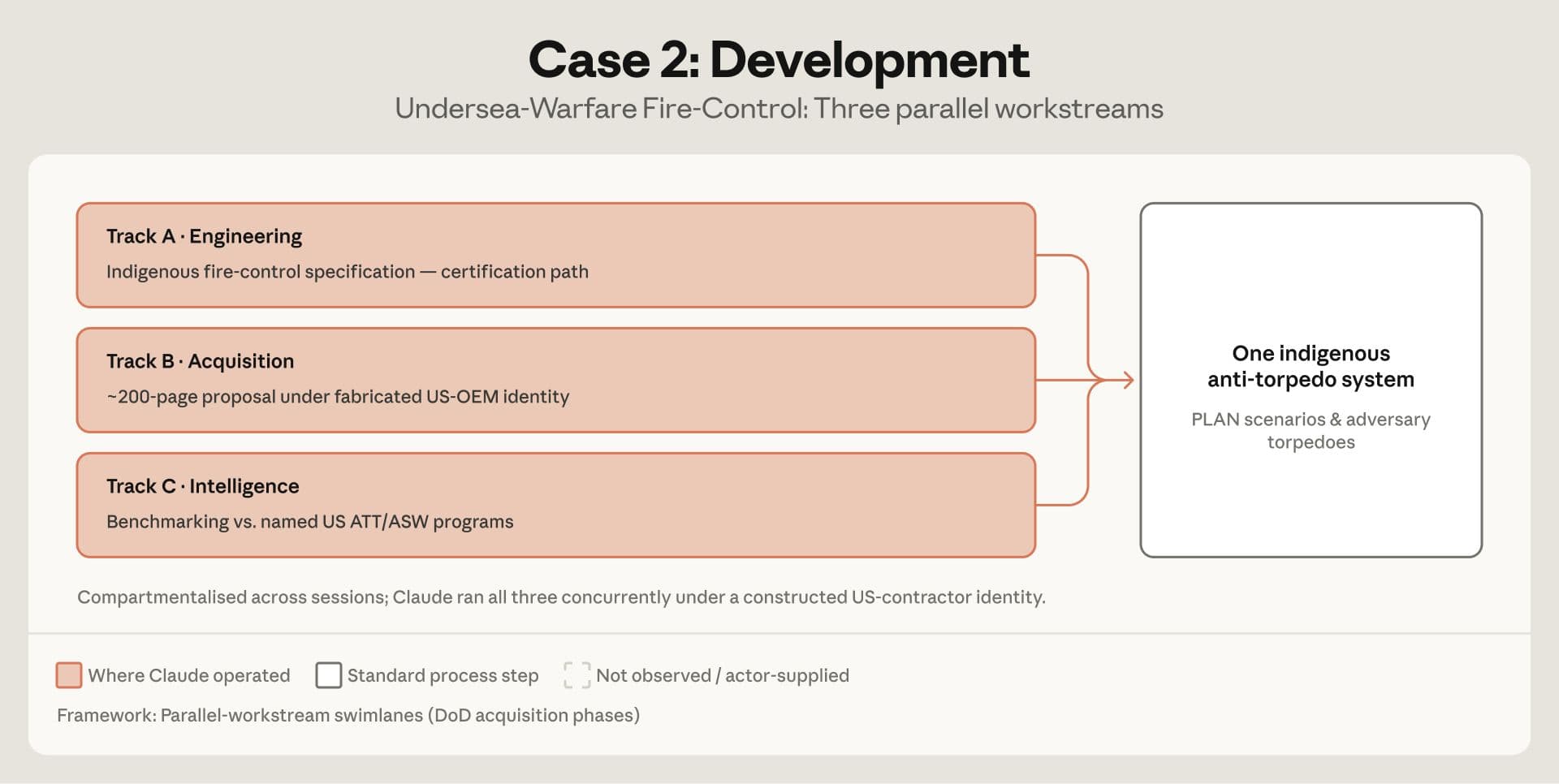
We identified a threat actor based in China who used Claude to advance three parallel workstreams for an anti-torpedo weapons system:
First, the actor used Claude to draft a Chinese-language specification for an anti-torpedo fire control system (the core logic for aiming and timing anti-torpedo weapon responses). The document was intended to obtain approval from a Chinese defense manufacturer, thereby advancing the work to technical certification and operational testing.
Second, the actor used Claude to produce a Chinese-language technical proposal of over 200 pages, accompanied by an executive briefing slide deck.
Third, the actor used Claude to benchmark its own system against specific US anti-torpedo and anti-submarine programs based on publicly available information. They then generated a Chinese-language briefing on US Navy systems based on open-source reporting.
The actor claimed to be an original equipment manufacturer in the US defense sector. We assess the actor to be linked to a Chinese defense industry manufacturer that aims to produce weapons specifications and procurement proposals for the People's Liberation Army Navy.
What AI did in this case
The actor used Claude to write the procurement proposal, refining it through multiple draft rounds. After each draft round, the actor instructed Claude to act as a hostile expert reviewer to critique the proposal, then used that feedback to improve the next version. At the same time, the actor used Claude to build parts of the anti-torpedo weapons system's fire control software and the test matrices to validate them.
The operational gain the actor achieved was using Claude to automate the production of complex technical outputs. The actor used the model to compress the development timeline for certification registration, compliance documentation, and automated fire control logic. The actor also accelerated the traditional human review cycle by having Claude play a role in multiple rounds of review to critique the procurement proposal.
What the report observed
The report confirms the existence of three parallel workstreams: a specification, a technical proposal, and a US program comparison briefing. The report confirms the actor claimed to be a US defense OEM but assesses it to be linked to China's defense industry.
Document generation does not equal actual weapons deployment. This site does not publish any technical specifications or fire control logic.
Confirmed & unknown
Confirmed
- The report confirms the actor used Claude to draft an anti-torpedo fire control system specification
- The report confirms the technical proposal was over 200 pages
- The report confirms the actor benchmarked against US programs
- The report assesses the actor to be linked to China's defense industry
Unknown
- The report does not state whether the system passed technical certification and operational testing
- The report does not fully disclose the actor's true identity and affiliated institution
- The report does not state whether these documents were used for actual procurement
Platform response
Anthropic banned the relevant accounts and incorporated the investigation findings into its safeguards to reduce the risk of future abuse.
Limits of response:Banning accounts cannot prevent the actor from continuing document work using other tools.
Takeaways
- AI can accelerate the generation of weapons specifications and procurement documents, compressing development timelines.
- Document generation does not equal actual weapons deployment; the planning stage must be distinguished from actual deployment.
- The actor claimed to be a US defense OEM but was actually linked to China's defense industry, indicating identity deception.