Conventional weapons · GTG-17002
Electronic Warfare and SEAD Target Analysis Software: Case GTG-17002
This page is a Chinese-to-English translation of content from pages 119–122 of Anthropic's September 2026 report. Institutional affiliation is the report's assessment. This site does not publish any target coordinates, weapons system parameters, or software logic.
According to the report, a Chinese actor used Claude's chat, coding, and agent work tools to design, build, and iterate on a Chinese-language electronic warfare software suite of about 16 modules, used to detect, jam, or spoof adversary radars and communications, and to suppress adversary air defense systems. The software analyzes adversary radars, air defense missile sites, command posts, and communication nodes, calculates their detection coverage, assesses jamming effectiveness, ranks targets by value and vulnerability, and determines how to best allocate jamming sorties. This page does not publish any target coordinates or software logic.
What happened
We identified an actor based in China who used Claude's chat, coding, and agent work tools to design, build, and iterate on a Chinese-language electronic warfare software suite of about 16 modules, used to exploit the electromagnetic spectrum to detect, jam, or spoof adversary radars and communications, and to suppress adversary air defense systems.
The actor used Claude to build the software system, from the underlying logic to the user interface, and iterated through 12 versions. This included implementing and optimizing the system's radar detection and jamming physics, generating vulnerability analysis modules, and drafting Chinese-language target instructions.
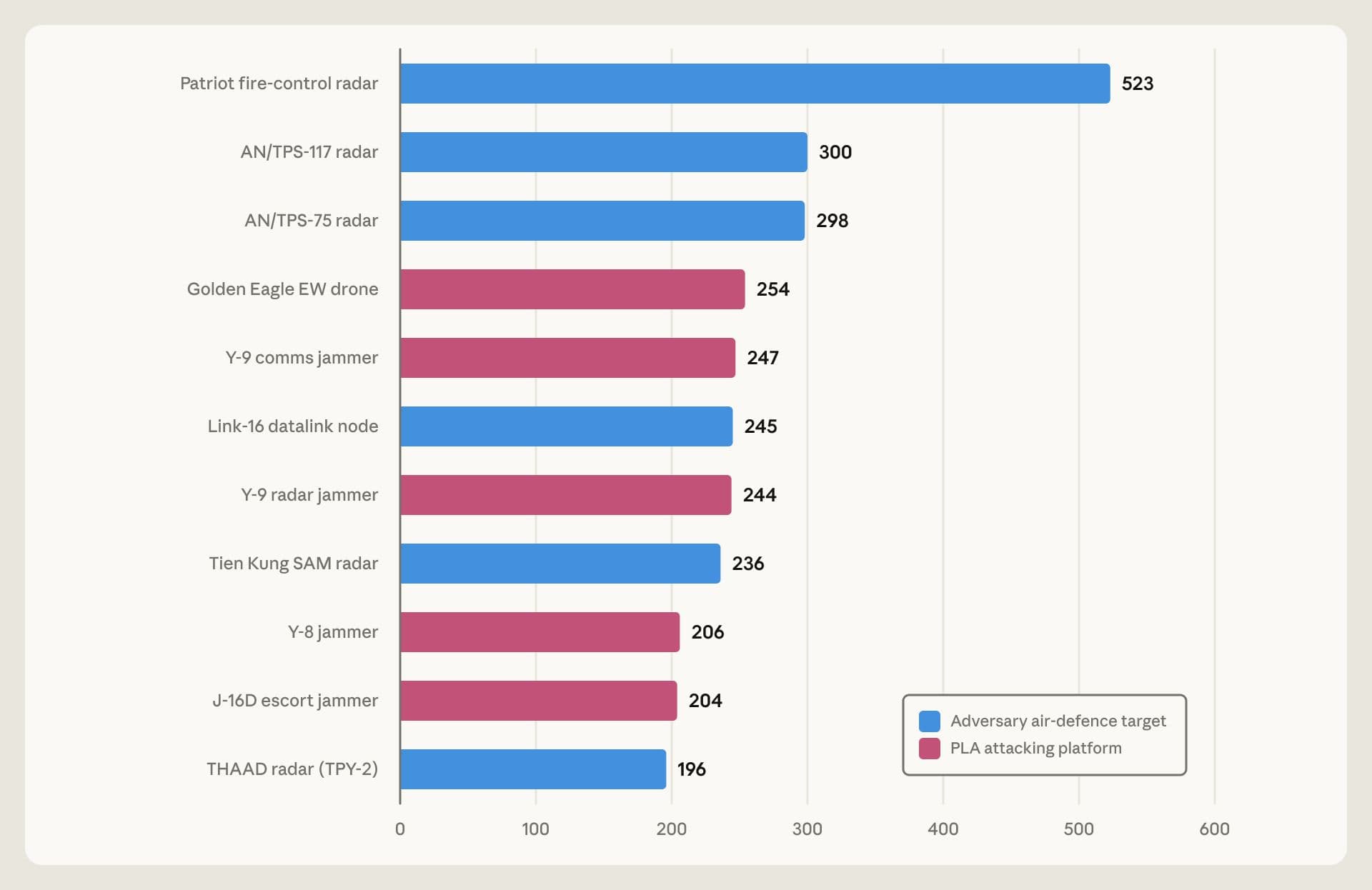
The software suite the actor built analyzes adversary radars, air defense missile sites, command posts, and communication nodes, then calculates their detection coverage, assesses jamming effectiveness, ranks targets by value and vulnerability (including which to suppress first), and determines how to best allocate jamming sorties over a multi-day campaign. The suite also ranks which adversary assets to suppress first and models specific engagement envelopes, including Patriot and THAAD-class systems.
Midway through the project, we observed the actor change the simulated default scenario to 12 targets in Taiwan. The targets included a Taiwanese command bunker, an early warning radar station, Patriot and Tien Kung missile sites, major air bases, and a theater command headquarters.
The actor also ran a self-hosted model on an internal network, in parallel with Claude, and connected the software suite to that model through tool-use integration.
Based on our investigation, we assess the actor to be a defense and military-industry researcher based in China. Account-level metadata and content flagged by our safeguards indicate the actor is affiliated with Chinese research institutions, including the People's Liberation Army Academy of Military Sciences. We detected this activity as part of an internal investigation into suspected weapons development, banned the accounts associated with the actor, and incorporated the investigation findings into our safeguards to reduce the risk of future abuse.
What AI did in this case
Claude was used to design, build, and iterate on the electronic warfare software suite, from the underlying logic to the user interface.
The actor used Claude to implement and optimize radar detection and jamming physics, generate vulnerability analysis modules, and draft target instructions.
The actor also connected the software suite to a self-hosted model through tool-use integration.
What the report observed
The report confirms the existence of an electronic warfare software suite of about 16 modules and 12 iterations. The report confirms the default scenario was changed to 12 targets in Taiwan.
The report assesses the actor to be affiliated with Chinese research institutions, including the People's Liberation Army Academy of Military Sciences.
This site does not publish any target coordinates, weapons system parameters, or software logic.
Confirmed & unknown
Confirmed
- The report confirms the actor used Claude to build an electronic warfare software suite of about 16 modules
- The report confirms the software was iterated through 12 versions
- The report confirms the default scenario was changed to 12 targets in Taiwan
- The report assesses the actor to be affiliated with Chinese research institutions, including the People's Liberation Army Academy of Military Sciences
Unknown
- The report does not state whether the software was used in actual military operations
- The report does not fully disclose the actor's specific identity and affiliated institution
- The report does not state the specific capabilities of the self-hosted model
Platform response
Anthropic banned the accounts associated with the actor and incorporated the investigation findings into its safeguards.
Limits of response:Banning accounts cannot prevent the actor from continuing software development using other tools.
Takeaways
- AI can accelerate the development of military software, including electronic warfare and air defense suppression systems.
- Software suites can analyze targets and calculate suppression sequences, lowering the barrier to planning.
- Changing the default scenario to Taiwan targets indicates the software may be aimed at a specific conflict scenario.