AI use in conventional weapons: judge by stage, not by scary names
Definition
This topic covers AI uses in the report related to conventional weapons development, design, intelligence collection, and procurement. Public articles follow a 'use case → observed progress → unknowns → governance implications' structure.
The core question is: did the model provide help with documents, software, or simulations, or is there evidence that a real capability was formed?
Not to be confused with
Not already-deployed weapons systems. Most cases stop at documents, development, or simulation.
Not a place where we provide parameters, coordinates, or ways to evade trade restrictions.
Not treating actors' self-reported funding as verified fact.
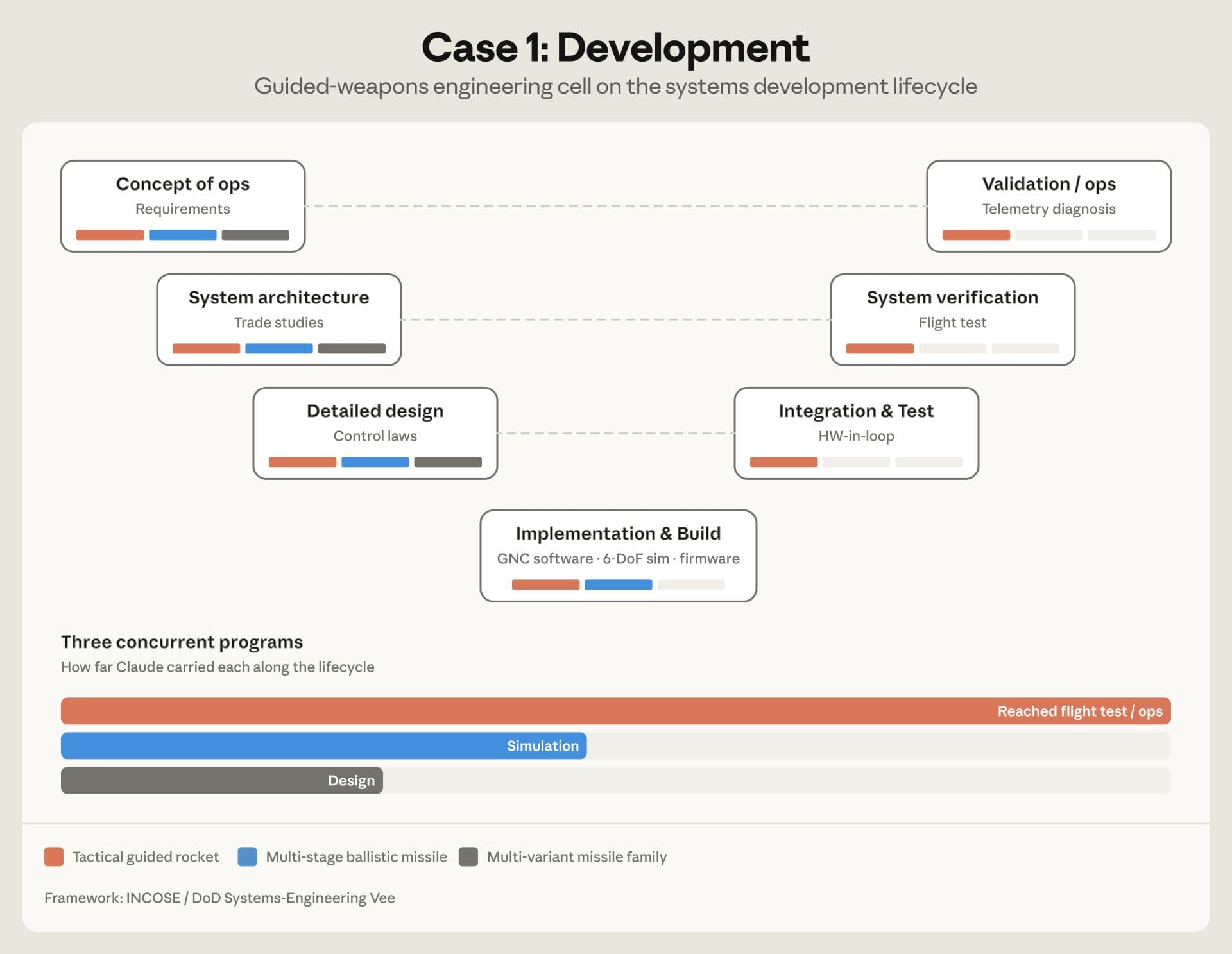
Original report figure: illustration of work in weapons-related cases. Text in the figure is the original English.
AI roles
AI mainly appears in specification drafting, software iteration, simulation testing, and procurement documents. Humans decide project goals and delivery targets.
Charts based on 'number of mentions' only show how often something was asked about, not that it can already hit accurately.
According to the report, a China-linked actor used Claude to advance three parallel document workstreams for an anti-torpedo weapons system: a Chinese-language specification, a technical proposal of over 200 pages, and a comparison briefing against US programs based on public sources. The actor claimed to be a US defense OEM; the report assesses it to be linked to China's defense industry. This page distinguishes document generation from actual weapons deployment and does not publish any technical specifications.
According to the report, a Chinese actor used Claude's chat, coding, and agent work tools to design, build, and iterate on a Chinese-language electronic warfare software suite of about 16 modules, used to detect, jam, or spoof adversary radars and communications, and to suppress adversary air defense systems. The software analyzes adversary radars, air defense missile sites, command posts, and communication nodes, calculates their detection coverage, assesses jamming effectiveness, ranks targets by value and vulnerability, and determines how to best allocate jamming sorties. This page does not publish any target coordinates or software logic.
According to the report, a threat actor based in China used Claude to collect open-source intelligence on advanced directed energy weapons, edit intelligence products, and draft Chinese-language briefings. The actor claimed to be a defense intelligence writer and internal publication editor, leading a three-person team. The actor attempted to identify a specific microwave-generating device and its supplier through iterative probability-weighted attribution, with the goal of reverse-engineering the weapon, developing countermeasures, and benchmarking it against Chinese systems. This page does not publish any weapons parameters or supply chain details.
According to the report, a freelancer likely based in Russia used Claude Code to write suicide drone swarm software called DronDoc / Serafim, and tested it in software-in-the-loop simulation, rented compute resources, and development boards. The report observed real hardware-in-the-loop testing, but overall the activity remained focused on simulation and development. Some funding connections are the actor's own unverified claims. This cannot be presented as established operational capability.
According to the report, an actor based in Russia used Claude to research and draft procurement documents for goods that can be used for both civilian and military purposes, potentially for Russian government and defense industry clients. At the center of the operation was a person claiming to be a procurement manager at a Moscow design bureau. The procurement involved German-made three-axis fluxgate magnetometers, thousands of space-grade photovoltaic wafers, aviation crew oxygen systems, and more. This page does not publish any supplier information or procurement details.
According to the report, a threat actor group in northern Yemen ran three weapons development programs: a guided rocket with terminal homing using commodity phone-grade flight computers, a multistage ballistic missile claiming a range of over 2,000 km, and the 'R2000' series of multi-variant missiles including a hypersonic glide vehicle variant. The actors used Claude Code in place of human software engineers to develop guidance, navigation, and control (GNC) software. The actors conducted a guided rocket test launch, which appears to have failed. This page does not publish any weapons software code or parameters.
Limits of response
This chapter requires separating planning, development, simulation, and real-world validation into distinct states. Unknowns are kept as a separate state, not filled in as success.
Civilian claims about dual-use items are assertions, not verified end uses.
The report mentions drone swarms — does that mean they're already combat-ready?
GTG-27005 is mainly at the simulation validation stage, with hardware-in-the-loop testing; funding relationships include unverified self-reports. It cannot be described as having formed an operational capability.
Why not disclose more technical details?
The details add no public understanding value but could lower the cost of harm for others. This topic focuses on governance and stage classification.