Influence operations · GTG-34001
Iran-Linked Influence Operation Planning: GTG-34001 Case
This page is an English translation of the relevant content from Anthropic's September 2026 report, pages 62–67. Organizational affiliations are the report's assessment; this site has not independently verified them.
According to the report, three accounts linked to Iranian state propaganda organizations used Claude to plan so-called "soft war" or "cognitive warfare" projects: campaign plans, persona systems, and target databases. The report links each of the three accounts to a different organization. These materials are primarily planning and preparation and should not be presented as fully executed.
What happened
We identified and removed three Iran state-aligned accounts that used Claude to build influence operation campaigns. The people behind them were planning and preparing content in support of what they called "soft war" or "cognitive warfare" projects. In their own words, this was a non-military plan to shape public opinion at home and abroad. Our investigation found that each operation was run by an actor working within or on behalf of a designated Iranian state propaganda organization.
These entities include the Islamic Culture and Communication Organization (ICCO), under the Ministry of Culture and Islamic Guidance; the Khorasan Razavi Islamic Propaganda Office, which runs a cognitive warfare command room at the Mashhad seminary and distributes content aligned with Islamic Revolutionary Guard Corps (IRGC) narratives; and the Bina Cultural Observatory of the Islamic Propaganda Organization.
In each case, the operation relied on Claude to build campaign plans, doctrinal manuals, persona systems, target databases, and ministerial-level planning documents. Using the model this way allowed them to generate complex organizational frameworks and assets that would otherwise have required a fully staffed project office to produce. The actors also placed heavy emphasis on attribution laundering; they designed content so that state-backed narratives would appear as independent voices. As the ICCO actor put it, their role as a cultural attaché was "not the narrator, but the director of these narratives."
The actors took deliberate steps to conceal their identities and origins. Because Claude is inaccessible from within Iran, they used VPNs and foreign phone numbers to register and verify accounts. Nevertheless, in conversations they repeatedly stated their location, institution, and role. These disclosures, along with institutional logos in document footers and open-source corroboration of the individuals involved, linked each operation to its Iran state-aligned institution.
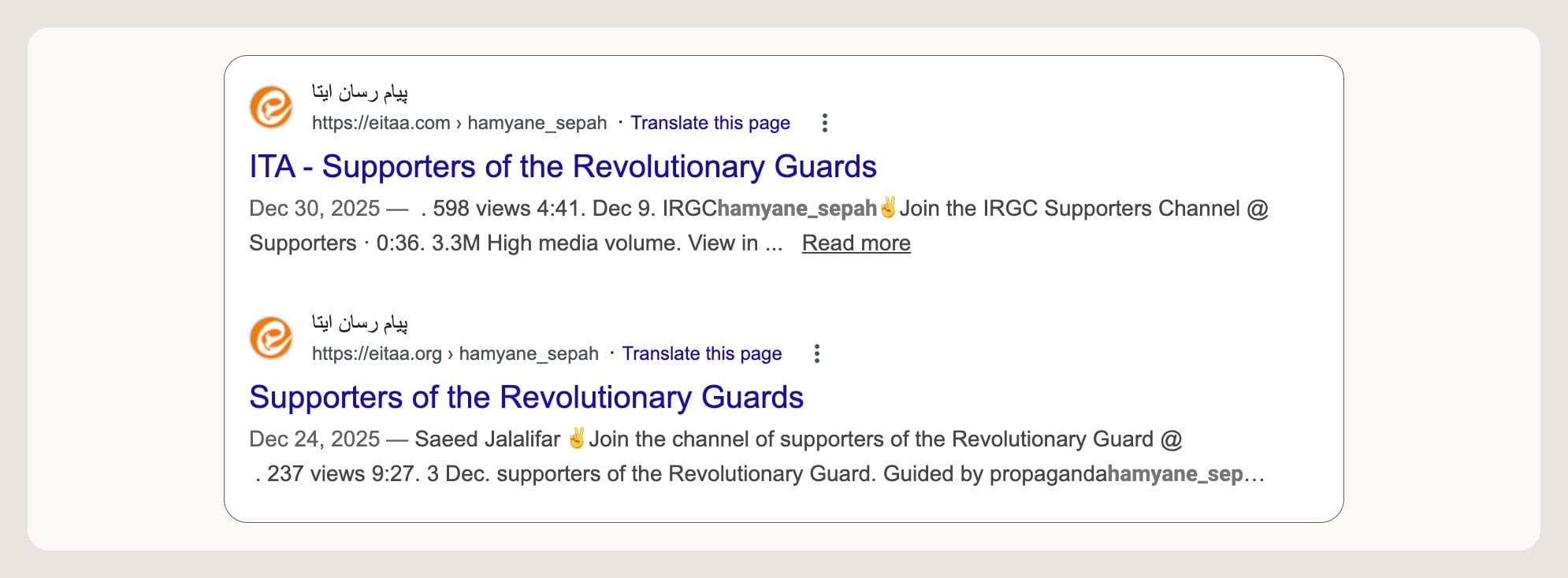
Our investigation also found some activity distributed across other platforms. For example, we observed content spreading through distribution channels consistent with IRGC narratives.
Using the Breakout Scale, we assessed this operation as Category 3 (multiple platforms, with content observed to be distributed by IRGC-aligned channels on Eitaa and other platforms).
What the AI did
Actors in all three operations explicitly linked their activities to the Iranian state doctrine of "Jihad al-Tabyin" (Jihad of Explanation). Under this concept, Iranian institutions treat producing propaganda as a religious and strategic duty. Language associated with this state doctrine appears directly in the actors' conversations and internal planning documents.
The network produced ministerial-level deliverables bearing the official ICCO logo. These deliverables detailed a nine-part international influence portfolio and a complete organizational plan for the funeral of Iran's Supreme Leader.
Public sources confirmed the roles of the strategic designer and commander leading the Mashhad command room. These leaders ran "Manjanegh" (Catapult), a multi-province content factory that used dozens of accounts to distribute content.
What the report observed
The report confirmed that the three accounts were each linked to a different organization. The report confirmed that the output consisted primarily of preparatory materials such as plans, personas, and databases. The report confirmed that the operators attempted to conceal their origins.
Preparatory materials do not equal a deployed propaganda network, nor do they equal changed attitudes among target audiences.
Confirmed & unknown
Confirmed
- The report confirms the three accounts were each linked to a different organization
- The report confirms the output consisted primarily of preparatory materials such as plans, personas, and databases
- The report confirms the operators attempted to conceal their origins
Unknown
- How much of this planning was actually executed externally is not fully confirmed by the report
- The actual impact on target audiences was not measured by the report
- Whether the three organizations operated under unified command is not stated as a confirmed fact in the report
Platform response
Anthropic removed the associated accounts.
Limits of response:Removing accounts disrupts use of the model; it does not mean the organizations stopped their propaganda activities through other channels.
Takeaways
- When reading threat reports, separate "planning" from "executed."
- Concealing sponsorship and disguising state narratives as independent voices is key to identifying deceptive influence operations—not the political views themselves.
- An operator's own strategic slogans cannot be treated as evidence that the intended effects were achieved.