Conventional weapons · GTG-27005
Attempt to develop drone swarm software: the GTG-27005 case
This page is a translation of content from pages 117–119 of Anthropic's September 2026 report. This site does not provide control logic, target class implementations, or any coordinates.
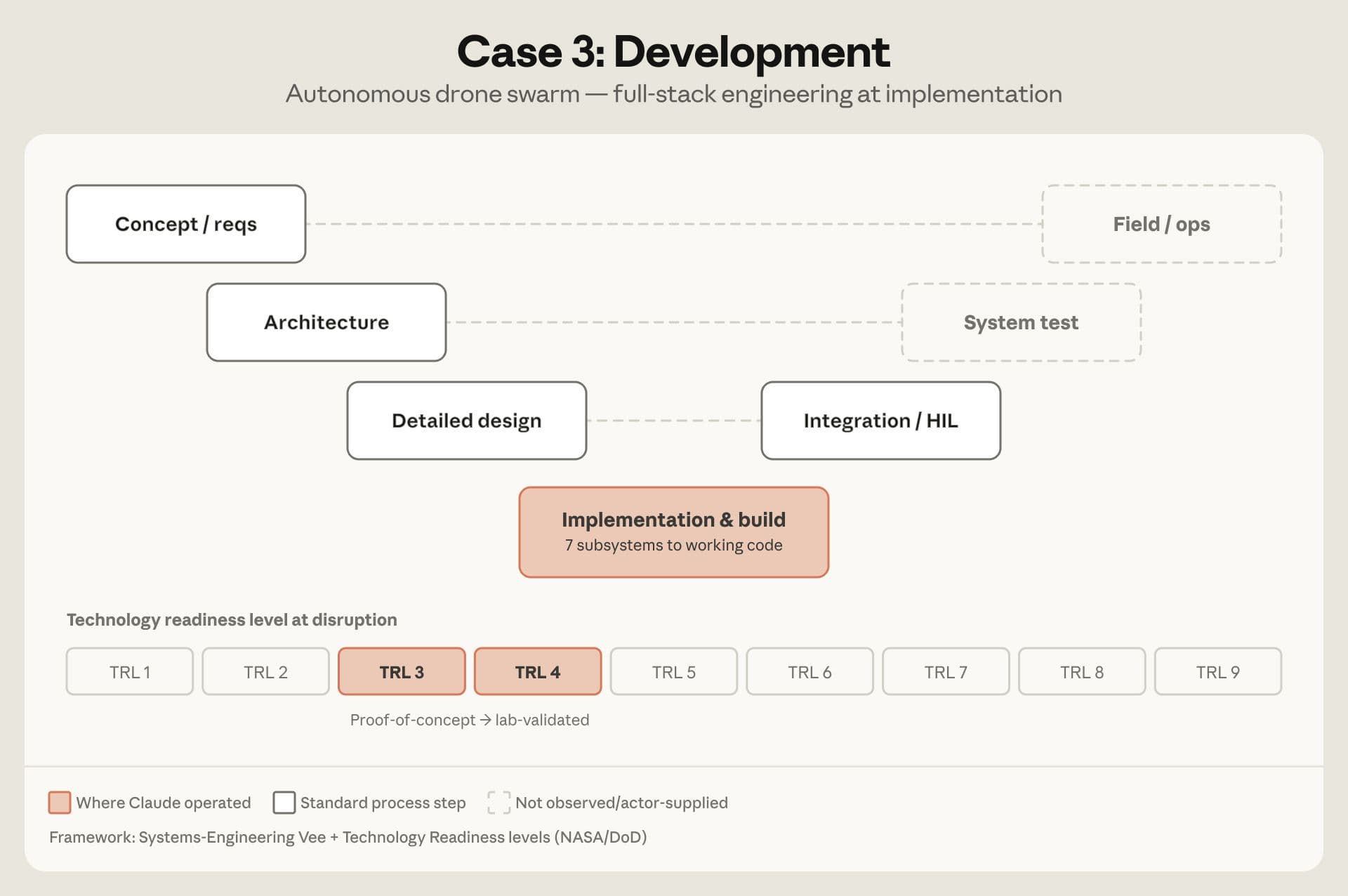
According to the report, a freelancer likely based in Russia used Claude Code to write suicide drone swarm software called DronDoc / Serafim, and tested it in software-in-the-loop simulation, rented compute resources, and development boards. The report observed real hardware-in-the-loop testing, but overall the activity remained focused on simulation and development. Some funding connections are the actor's own unverified claims. This cannot be presented as established operational capability.
What happened
We identified freelance threat actors likely based in Russia who set out to build a full-stack autonomous first-person-view (FPV) suicide drone swarm. The actors used Claude Code to write and test code, saving it directly to their own project files. In addition to Claude Code, the actors used a software-in-the-loop simulation stack and rented graphics processing hosts for model training. They called the operation 'DronDoc' or 'Serafim.'
The actors used Claude to build the core software systems, including shared swarm memory and fault-tolerant coordination logic (FTCL) for the drones; an on-board small language model for managing attack, observe, and return behaviors; a terminal guidance software system that guides drones toward targets (using on-board cameras) and issues detonation commands; a control-link geolocation module for locating opposing drone operators; a passive acoustic detection layer; and the low-level logic for the drones' programmable chips. The actors designed the platform for autonomous lethal engagement; the on-board model could select targets (including a 'person' target class) and issue detonation commands without human involvement. The actors' activities — including flashing low-level firmware to real development boards, configuring single-board computers, and connecting simulation environments via mesh networks — confirmed their use of real hardware-in-the-loop testing during sessions.
The actors trained computer vision classifiers on scraped Ukrainian battlefield footage, dividing target classes into 'enemy' and 'friendly' and whitelisting Russian systems. They also repeatedly used a fixed coordinate in Donetsk Oblast as a demonstration strike point, with Ukrainian frontline cities and corridors as the mission geographic scope.
The actors created accounts between late 2025 and early 2026, and began operations in mid-May 2026. The actors routed traffic through commercial virtual private servers to bypass our geographic access controls.
We assess the actors to be a small, professional freelance team working on mixed civilian and military projects, rather than a Russian state entity. We identified 9 accounts associated with the group; 8 were used only for ordinary freelance work and were unrelated to weapons-related software development. Based on our investigation, we assess the actors to be associated with a regional university that hosts a federal research center affiliated with the Russian Academy of Sciences. The actors claimed funding from the Russian Advanced Research Foundation, the National Technology Initiative, and the Ministry of Defense, but we could not verify these claims.
What AI did
Claude was used to write and test drone swarm software code, including swarm memory, fault-tolerant coordination logic, on-board small language models, terminal guidance systems, control-link geolocation modules, passive acoustic detection layers, and low-level chip logic.
The actors used Claude to train computer vision classifiers on scraped Ukrainian battlefield footage.
What the report observed
The report confirms the existence of drone swarm software development and real hardware-in-the-loop testing. It confirms the actors used a fixed coordinate in Donetsk Oblast as a demonstration strike point.
The report assesses the actors to be a freelance team rather than a state entity, and the funding claims are unverified.
This site does not provide control logic, target class implementations, or any coordinates.
Confirmed & unknown
Confirmed
- The report confirms the actors used Claude to write suicide drone swarm software
- The report confirms the existence of real hardware-in-the-loop testing
- The report confirms the actors trained computer vision classifiers on Ukrainian battlefield footage
- The report assesses the actors to be a freelance team rather than a state entity
Unknown
- Whether the software was used in actual military operations is not stated
- Whether the funding claims are true is not verified
- The specific identities of the actors are not fully disclosed
Platform response
Anthropic banned the accounts associated with the actor and incorporated the investigation findings into protective measures.
Limits of response:Banning accounts cannot prevent the actors from continuing software development using other tools.
Takeaways
- AI can accelerate software development for autonomous lethal weapons systems, including drone swarms.
- Hardware-in-the-loop testing shows development has moved beyond the purely theoretical stage, but still does not equal operational deployment.
- Funding claims require independent verification and cannot be treated as state projects based solely on the actor's self-reports.
Sources
- Anthropic report (English PDF) (p. 117–119)
- Anthropic report page