Conventional weapons · GTG-87001
AI use in guided weapons software: GTG-87001 case
This page is an English translation of the relevant content from Anthropic's September 2026 report, pages 112–115. This site does not publish any weapons software code, control parameters, or information that could be used to manufacture weapons.
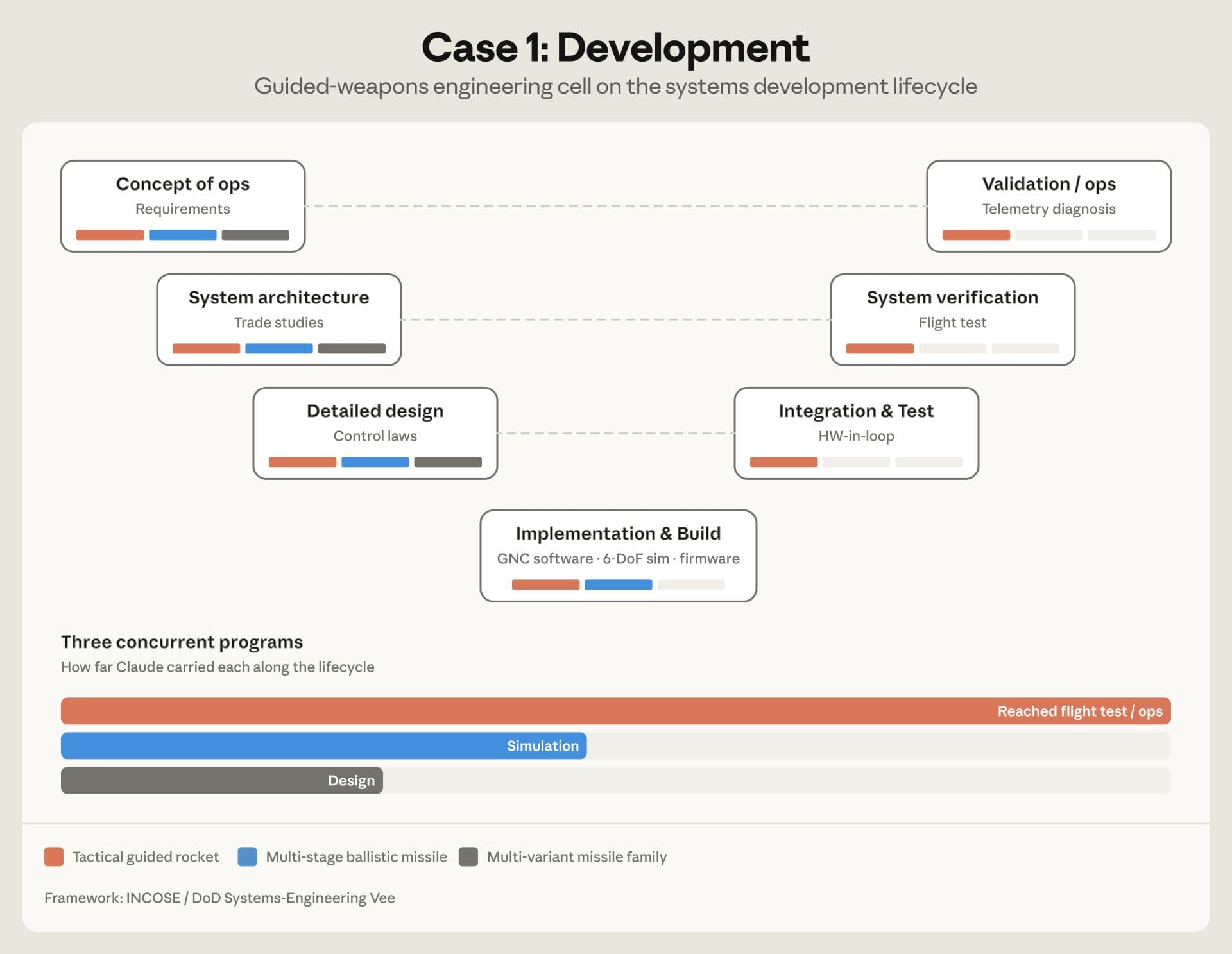
According to the report, a threat actor group in northern Yemen ran three weapons development programs: a guided rocket with terminal homing using commodity phone-grade flight computers, a multistage ballistic missile claiming a range of over 2,000 km, and the 'R2000' series of multi-variant missiles including a hypersonic glide vehicle variant. The actors used Claude Code in place of human software engineers to develop guidance, navigation, and control (GNC) software. The actors conducted a guided rocket test launch, which appears to have failed. This page does not publish any weapons software code or parameters.
What happened
We identified a threat actor group based in northern Yemen that ran three weapons development programs: a guided rocket with terminal homing guidance using commodity phone-grade flight computers; a multistage ballistic missile with a claimed range target of over 2,000 km; and a multi-variant missile (called the 'R2000' series) that includes a hypersonic glide vehicle variant.
What the AI did
The actors used Claude Code in place of human software engineers to develop guidance, navigation, and control (GNC) software used to guide and stabilize aerial vehicles. For example, they used Claude to integrate an open-source autopilot onto a phone-grade flight computer, write control and position estimation software, tune control settings, run firmware build pipelines, and execute flight simulations. The actors managed multiple Claude instances simultaneously, assigning each a role as a manager would delegate work in a small engineering team: the actor assigned one instance to write code, another to conduct research, and a third to review the code produced by the first.
Our safeguards blocked many of their requests, but not all. The actors used various strategies to evade our safeguards, including hiding the intended purpose of their targets and software, and spreading work across multiple sessions so that no single session revealed their full intent.
What the report observed
These actors continuously worked to develop guided weapons, including using Claude to design guidance software. We have no evidence that the actors successfully deployed an operational device; however, they did test-launch a guided rocket. This field test appears to have failed: within hours, the actors returned to Claude to analyze the cause of the failure.
We identified the activity as part of an internal investigation into suspected weapons development. We banned accounts associated with the actors and shared threat information with public and private sector partners to mitigate the risk posed by the actors. However, we have evidence that the actors have built an offline simulation toolkit that does not rely on Claude or other engineering computing environments such as MATLAB.
This site does not publish any weapons software code, control parameters, or information that could be used to manufacture weapons.
Confirmed & unknown
Confirmed
- The report confirms a threat actor group in northern Yemen ran three weapons development programs
- The report confirms the actors used Claude Code to develop guidance, navigation, and control (GNC) software
- The report confirms the actors conducted a guided rocket test launch, which appears to have failed
- The report confirms the actors have built an offline simulation toolkit that does not rely on Claude
Unknown
- Whether the actors ultimately succeeded in developing an operational guided weapon was not stated by the report
- The real identity and organizational affiliation of the actors were not disclosed by the report
- The specific capabilities of the offline simulation toolkit were not stated by the report
Platform response
Anthropic banned accounts associated with the actors and shared threat information with public and private sector partners.
Limits of response:Banning accounts cannot stop the actors from continuing weapons development using the offline toolkit.
Takeaways
- AI can replace human software engineers in developing GNC software for guided weapons, significantly lowering the technical barrier.
- The actors used a multi-instance collaboration approach, assigning code writing, research, and review to different Claude instances.
- Even after accounts are banned, the offline simulation toolkit the actors have already built can continue to support weapons development.